So here we are again, talking about piss. Fascists in our streets and in the Houses of Parliament, a government in total collapse and our planet on fire. Yet the real burning issue seems to be who can piss where and why? To understand how we got here, it’s important to give a brief history of the last few years.
HOW DID WE GET HERE?
For Women Scotland (FWS), a hate group targeting trans people, was founded in 2018. It received tens of thousands in crowdfunding including a large sum from a well known children’s author. In December 2022 For Women Scotland requested a judicial review, with the intention of reinterpretting the Equality Act of 2010 so that the terms ‘man’ and ‘woman’ would only refer to those who were born as the corresponding sex and not those who had transitioned into it. The Outer House (the highest national court of Scotland in relation to civil cases) dismissed the petition stating that the language in the challenged section of the Gender Recognition Act 2004, upon which the Equality Act of 2010 had built on, “could scarcely be clearer”. They are right.
“Where a full gender recognition certificate is issued to a person, the person’s gender becomes for all purposes the acquired gender (so that, if the acquired gender is the male gender, the person’s sex becomes that of a man and, if it is the female gender, the person’s sex becomes that of a woman).”
Whilst I absolutely do not believe that somebody needs a certificate to tell them who they are and have always been, it is pertinent to note just how unequivocal this statement is. Despite this in late 2024 FWS took their appeal to the Supreme Court, which refused to hear interventions from trans advocacy groups, and on April 16th 2025 unanimously ruled in favour of FWS. On May 21st 2026 the Equality and Human Rights Commission (EHRC) submitted a ‘Statutory Code of Practice’ to Parliament, which takes into account the Supreme Court decision and sets out a guideline for businesses and facilities to follow with regards to the provision of single-sex spaces and services. After 40 days sitting with the government, usually a formality, the Code will come into force.
WHAT DOES THE CODE ACTUALLY SAY?
The Code is long and covers a variety of topics and situations. I have focused on the sections pertaining to the provision of single-sex spaces, aiming to understand how we, as hospitality workers, can ensure that trans people can continue to enjoy our venues, which are also their venues, with confidence and dignity. Rather than copy and paste bits of the Code, I have attempted to simplify some of the key points. I know this is a lot of information, please believe me when I say I’ve tried to simplify it as much as possible:
- If a service provider wants to provide a single-sex space, they must do so with a legitimate aim in mind, balancing out the benefits to the recipients with the impacts on those excluded. (This is important, because the starting point is assumed to be mixed-sex spaces). In the case of single-sex spaces for women, if women’s safety/privacy/dignity are deemed to be compromised by a lack of a women-only space, then the benefits of providing the single-sex space will hold larger weight than the disadvantages.
- For the purpose of single-sex spaces trans men will be excluded from male-only spaces and trans women from female-only. The Code acknowledges the disadvantage this brings to trans people and says that the provider must think about whether the negative impact on trans people outweighs the original aim that was used to justify the single-sex spaces existence in the first place.
- If a service provider decides to only provide their service on a mixed-sex basis then that could leave them open to legal challenges based on discrimination, most likely against women.
- The ideal outcome would be that services provide single-sex spaces and then also a mixed-sex service, but the guidelines acknowledge that this is not always possible due to constraints such as space and financial limitations.
- It is advisable for service providers to record their reasoning when deciding whether to provide single-sex spaces, with evidence if possible.
- If a service provider allows trans people to use single-sex spaces then the space ceases to be single-sex and the provider leaves itself open to legal challenge with regard to sex discrimination. I.e. If a provider allows trans men to use a male-only space, then it leaves itself open to legal challenge from cisgender women who could question why they are being excluded from it.
- The Code allows room for exceptions to these rules for things like women bringing their male children into a women-only space. This is because the aim of providing the space (the safety/dignity/privacy of women) is not seen to be compromised by a child.
- If a service provider has come to a decision to provide same sex spaces on the basis that the presence of trans people could be distressing for other users of the service then they must approach the exclusion of trans people from these spaces on a case by case basis taking into account such factors as the ability of the trans person to ‘pass’ as their chosen gender. Ridiculous and insulting.
- This point is so important I am going to copy and paste it directly. “13.148 The service provider should consider whether there is a suitable alternative service for the trans person to use. In the case of services which are necessary for everybody, such as toilets, it is very unlikely to be proportionate to put a trans person in a position where there is no service that they are allowed to use.” Also. “13.149 If the service provider does not act proportionately, this is very likely to amount to direct or indirect discrimination because of gender reassignment.”
- If it is clear that people of the opposite sex are accessing a service then it is advised for service providers to inquire whether they are using the appropriate service for their sex, but to do so in a manner as to not cause distress to the person in question (this is later completely contradicted which I will come onto.)
It is important to note that the legal obligations of this Code are all on the service providers. A trans man using a single-sex male bathroom, or a trans woman using a single-sex female bathroom, would not be doing anything illegal.
WHAT DOES THIS MEAN FOR TRANS PEOPLE’S ACCESS TO HOSPITALITY VENUES AND WHAT SHOULD VENUES BE DOING?
There are so many grey areas and contradicting statements in the Code that it is difficult to tell what the right course of action to take is to ensure trans people are able to continue to use our venues in a way that makes them feel not just comfortable, but welcome.
It is clear that what the Code really wants is for every venue to have three bathrooms, two single-sex and one mixed-sex, even if the mixed-sex doubles up as the disabled access toilet. If this is not possible due to size constraints or financial pressure, then the next best alternative would be to have a series of individual lockable rooms which each contain a toilet and a hand basin, all of which would be mixed-sex. Personally I find the idea of having two single-sex bathrooms and one mixed-sex to be segregational and demeaning to trans people, but I am cisgender and I cannot speak for trans folks on this issue.
Things look trickier for venues which have been designed to have two large communal single-sex toilets. If they have the room and financial power to add a mixed-sex toilet then that is still clearly the outcome the Code prefers. If not, then they have two options, both of which revolve around the exploitation of a single clause in the Code:
13.170 It is unlikely to be either practical or appropriate to approach any particular individual to make enquiries about their sex in relation to facilities, such as toilets, which are incidental to the primary service.
If we take this clause at face value it provides us with two arguments:
- The provision of toilets is incidental to the service providers primary services. and thus not subject to the same scrutiny concerning the protection of single-sex spaces.
- If it is advised to not approach individuals to enquire about their sex with regards to toilets, then the policing of those spaces as single-sex completely becomes completely unrealistic.
We can use these arguments to justify the approaches we, as hospitality venues, take to interpreting the Code in a way that allows us to remain trans-inclusive. For many venues the simplest course of action will be to adapt what they already have. For venues with mixed-sex bathrooms this would be utilising the first argument, above, to argue that toilets are incidental to the primary service and not therefore subject to the same scrutiny as the services whose primary service concerns the provision of single-sex spaces. Venues with single-sex bathrooms can utilise the second argument above, maintaining a policy of non-policing, arguing that they have never been policed and that the guidance itself advises against policing spaces such as toilets with regards to sex.
It is important to note that both of these two options have the potential to leave venues open to challenges of discrimination. Under the EHRC Code if a service provider allows a trans woman to use a single-sex space then the space ceases to be single-sex and the provider leaves itself open to challenges from cis men as to why they are being excluded from said space.
I would strongly recommend venues seek out the opinions of their transgender customers, as to what can be done to make them feel safe and comfortable when using the bathroom in their venue. Ultimately I’m not a lawyer, just a hospitality worker amongst hundreds of others trying to make heads and tails of this farce. I am also someone who cares deeply about the UK hospitality sector, trans rights and the right to self-identification. I will not be held legally responsible for anyone who acts solely on my advice, and would advise other workers to read the EHRC Code for themselves. I am simply sharing my interpretation in the hope that it helps others to come to their own decision. There is no blanket solution to this, and each venue will have to approach their own solution with care and empathy, with their own interpretation of the Code.
MAKING YOUR STANCE KNOWN
It is not enough to just have systems in place that are designed to be inclusive. Trans folks are anxious, the social and legal barriers to public life that are being erected in front of them are one thing, but we also need to take into account the emotional constraints. It is imperative that if you want your venue to be trans inclusive, you must make your position clear. We must work to help alleviate the anxiety that this evil Code is placing on the trans community, and simultaneously make sure that those who would sow more division know that they are not welcome to do so in our venues. Here are some small and easy things we can do:
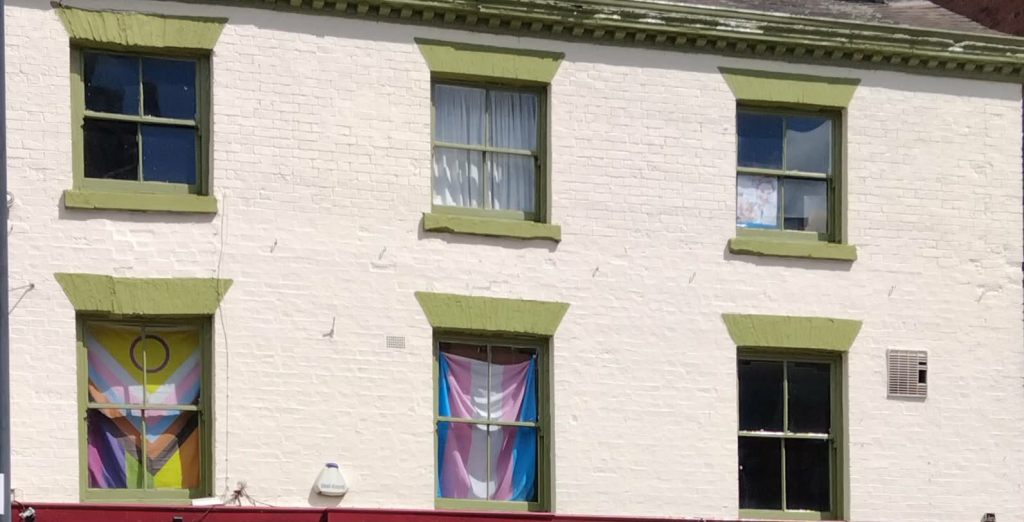
- Hang trans flags and progress pride flags where they can be clearly seen by everyone, inside and out of the venue.
- Post on Social Media to let trans folks know they will always be welcome at your venue.
- Approach local LGBT+ and trans-specific charities about having collection boxes on your bar.
- If you have spaces like function rooms or private areas, approach local trans social groups and let them know you are happy to let such spaces out to them for free.
- Make sure all of your staff are trained on using gender neutral and gender appropriate terms, and that they are well educated on the areas of the Code that they may need to quote if they are confronted by members of certain groups.
- Buy a selection of trans supporting pins/badges/lanyards that your staff may choose to wear. This will make it easier for trans folks to approach certain staff members when they are concerned or anxious about something.
- Be patient. Be kind. It is likely that the weeks following the enforcement of the Code will be of heightened emotions. Listen to transgender people, be compassionate and understanding when emotions run high.
THE WIDER POLITICAL CONTEXT
This has been a concentrated effort to remove the rights of an already persecuted section of society by a collective of right wing activists. The face of the campaign has been small groups of women who have been convinced that the mere existence of trans women is the single largest threat to cis women like them. (“Like them” is an important distinction because these same groups are conspicuously silent on all political issues affecting women that aren’t related to gender identity). Behind them, the scope widens. For the last few years the entire political spectrum in the UK has been shifting further right, and in the past year we have witnessed, what is in essence, a trial run. A testing of the waters for the removal of the entrenched rights of British Citizens. Typically the progression of civilisation can be tracked in the granting of rights to citizens and the protection of marginalised groups. The removal of such rights is a relative rarity and signals regression.
It is tempting to frame it as a two pronged attack consisting of the gender critical women’s campaigns and the far right, but the reality is that it is more like a single, skewered prong, because this campaign of sustained bigotry and dehumanisation is also steeped in misogyny. The same people who campaigned for the removal of trans women from women-only spaces, will soon find themselves the subject of intense, unwanted scrutiny about the degree and validity of their own femininity. I entirely fail to see how the policing of women’s bodies and the enforcing of traditional femininity could be seen as an advancement for women’s rights, rather than a turning back of the clock.
Although it is important to think about the societal shifts that have led us to this point, it’s equally important not to lose sight of the tangible effects on the lives of trans people in the UK. Hundreds of thousands of people have had to watch on in horror as their existence has been endlessly debated, without them ever having a say. They have had their public lives turned upside down by a vocal, hateful minority. I am heartbroken for my trans siblings and forever in awe of their displays of courage and endurance in the face of such relentless, needless cruelty.
This is not, and has never been, about the protection of single-sex spaces. Rather, it is a flagrant attempt to remove trans people from public life.
TO MY TRANS SIBLINGS
The people who have pushed through this cruel Code are a vocal minority. The vast majority of the population are more concerned about how they are going to pay their next leccy bill than where you relieve yourself. Many of us love you, many of us support you unequivocally. As a hospitality worker I will do everything I can to make sure you feel comfortable in the venues I work at, and there are thousands, like me, who would sooner find themself unemployed than to compromise your human right to live your life with dignity and respect. As a fellow member of the LGBT+ community I stand side by side with you. You are wonderful, please keep being wonderful; one day society will look back at this time as a deeply dark one, and when that time comes you will still be here and you will still be wonderful.
FINALLY
It is entirely likely I have missed something important, or gotten something wrong. I’m more than happy to be corrected and to edit this post to rectify mistakes, so don’t be afraid to get in touch. Similarly if you are a hospitality worker and you want someone else to talk about the Code to, then feel free to get in touch I will do everything I can to help. If you are a member of the trans community who is anxious, again you can message me, I doubt I can help, but I will always listen. Anyone who decides to respond to this with vitriol will simply have their response deleted and they will be blocked. I ask anyone who sees vitriol in response to this post to not engage with it, message me instead and I will simply remove it. The voice of hate must be silenced, not amplified.
Trans rights are human rights. Everyone deserves to live out their chosen life with dignity and respect. Everyone deserves access to community. Pubs are for everyone or they are for no-one at all.
 CasKapital
Leave a comment